Why Some Places Feel Different: Landscape, Memory and the Experience of the Sacred
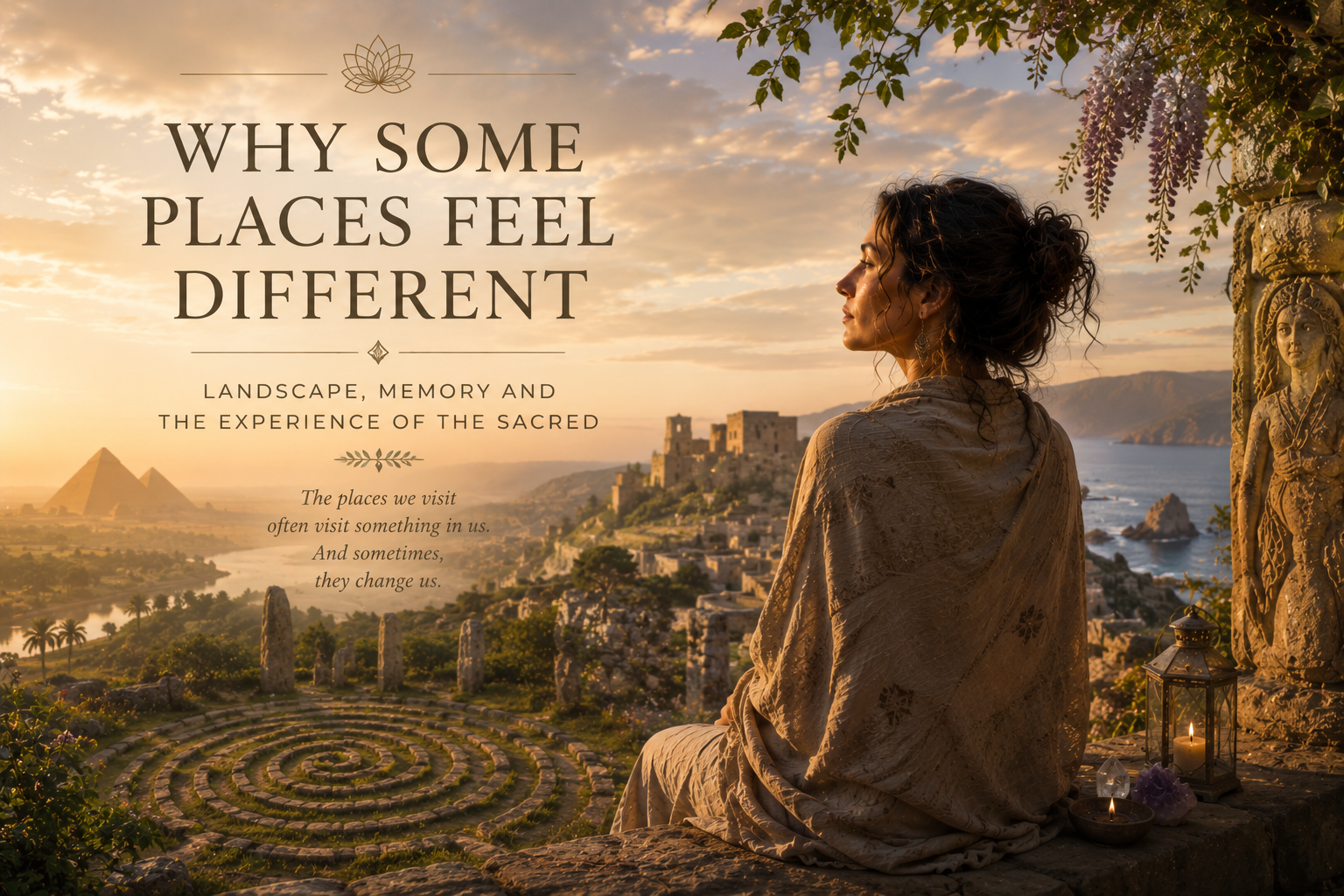
Have you ever arrived somewhere you have never been and felt strangely moved?
Nothing dramatic necessarily happens.
And yet something about the place seems to reach you.
Perhaps you become unusually quiet.
Perhaps emotion rises unexpectedly.
Perhaps there is a feeling of recognition you cannot quite explain.
Human beings have identified certain landscapes as sacred for thousands of years.
Mountains.
Springs.
Caves.
Rivers.
Groves.
Deserts.
Temples.
Stone circles.
Places of burial.
Places of pilgrimage.
Some have been considered holy by multiple cultures across different periods of history.
Why do certain places affect us so deeply?
There may not be one answer.
Landscape Shapes Experience
Part of what we experience in sacred places may simply be the extraordinary power of landscape.
A cave changes our perception.
Sound becomes different. Light disappears. The world outside recedes.
A mountain changes us in another way.
Our visual field expands. The body encounters altitude, wind, distance, and scale.
Standing beside the ocean can create yet another state entirely.
The horizon seems endless.
Our problems temporarily become smaller.
We remember that we belong to something vastly larger than the world inside our own minds.
Human beings evolved in relationship with landscape.
Perhaps it should not surprise us that particular environments affect consciousness.
The Places Where Humans Have Prayed
But landscape alone may not explain everything we experience.
There are places where generations of people have gathered with intention.
To pray.
To grieve.
To heal.
To initiate.
To worship.
To bury their dead.
To encounter the divine.
Walking into such places can create a powerful psychological experience.
We know that others stood where we are standing.
We imagine their hopes.
Their suffering.
Their devotion.
Their questions.
History becomes almost tangible.
I have felt this in my own travels.
There are places I have visited where the experience could not be reduced to sightseeing.
In Egypt, southern France, and the ancient landscapes surrounding Glastonbury, I found myself responding not only to what I could see, but to something more difficult to name.
Perhaps it was history.
Perhaps symbolism.
Perhaps the stories I carried with me.
Perhaps the landscape itself.
Perhaps something I do not yet understand.
I have become increasingly comfortable allowing that question to remain open.
Pilgrimage Changes the Traveler
There is another possibility.
Perhaps sacred places feel different partly because we arrive differently.
A pilgrimage is not the same as a vacation.
We approach the destination with intention.
We have already decided that the journey matters.
We may spend months imagining it.
Reading.
Preparing.
Wondering what we will encounter.
By the time we arrive, our attention has changed.
We are receptive.
We notice.
We listen.
And receptivity changes experience.
This does not make the experience unreal.
It simply reminds us that sacredness may arise through relationship.
Between person and place.
History and imagination.
Landscape and body.
Story and memory.
Visible and invisible.
Can Land Hold Memory?
Many spiritual traditions suggest that places can carry energetic imprints.
Science does not currently give us a basis for confidently claiming that landscapes literally store emotional or spiritual events in the way human memory does.
And yet the metaphor of land holding memory remains powerful.
Places certainly hold evidence.
Ruins.
Graves.
Paths worn by countless feet.
Buildings oriented toward stars.
Names carried through generations.
Stories embedded in communities.
And our bodies respond to those traces.
Perhaps the more interesting question is not whether we can prove that a place contains an invisible energy.
Perhaps it is:
What happens in us when we encounter a place that generations before us considered sacred?
Sacredness as Relationship
Some places seem to ask something of us.
To become quiet.
To remove our shoes.
To touch the earth.
To listen.
To remember.
The sacred may not be a quality we can measure in the landscape.
Perhaps it emerges in the relationship between consciousness and place.
The land meets us.
We bring our history, longing, imagination, body, and attention.
Something happens between the two.
And sometimes we leave changed.
Not because we can explain exactly what occurred.
But because for a moment we experienced ourselves differently in relationship with the world.
Perhaps that is enough to make a place sacred.
Victoria Pekhnik, LMFT
Awakened Potential Therapy, LLC
Bridging Psychology, Somatic, Sound Healing & Energy Work
Reiki Master | Kundalini Yoga Teacher (300 RYT) | Sound Healing Facilitator
Phone: 347-495-7163
Website: www.victoriapekhnik963Hz.com
Instagram: @victoriapekhnik
Facebook:Victoria Pekhnik
TikTok: @victoriapekhnik